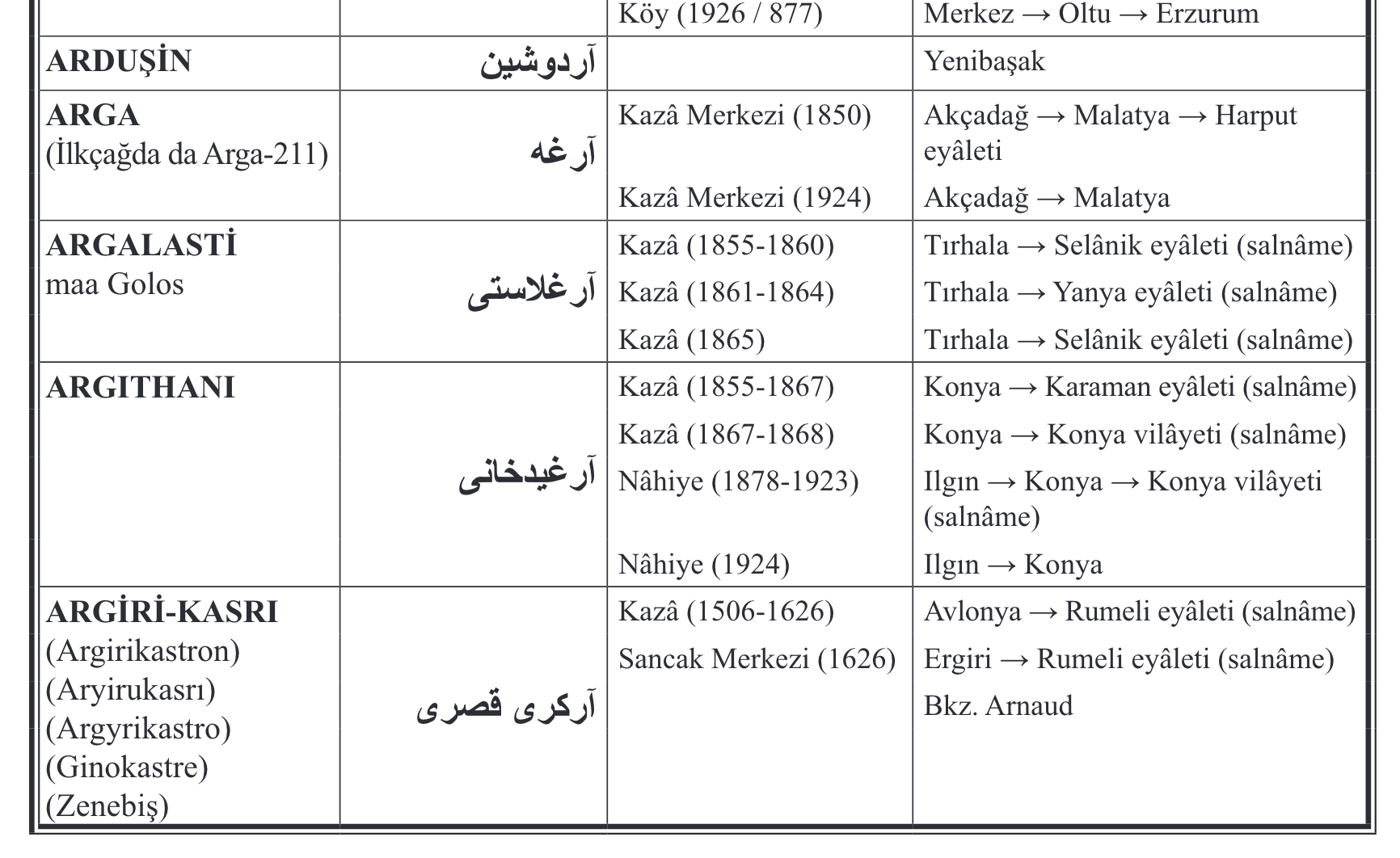
In most cases, the hierarchy of places that Sezen gives is clear: a district is located in a subprovince that is located in a province. Each of these is an instance of a “territorial administrative entity.” Sometimes, however, Sezen locates places in periodic events (such as military occupations) rather than in territorial entities (such as provinces). He uses four such categories, in almost 500 entries:
- yönetim (rule)
- işgal (occupation)
- hâkimiyet (control)
- idare (administration)
It’s clear that these labels are different in nature from the place descriptors used in most of Sezen’s regional hierarchies. I have chosen to describe all of these items as “periods of contested sovereignty.” Of course, we can find plenty to quibble with in any general description of a specific historical instance. But in data terms, how should we model this difference?
I always look first to wikidata, to see if there’s a widely adopted model. (Clicking on “what links here” tool on the left hand menu of a page gives a good sense of how a concept is actually being used.) Unfortunately, the answer is not altogether satisfying. “military occupation” (Q188686) is widely used, but it doesn’t fit Ottgaz purposes as well as it might. For one thing, it’s defined as a subclass of “military operation” (Q645883) that follows “conquest” (Q1361229). This works for some but not all of the cases in our domain. sovereignty (Q42008), as it is currently used in Wikidata, connotes the idea rather than the practice. “protectorate” (Q164142) might offer a better fit in some senses, but it is a subclass of “client state” (Q1151405) and “dependent territory” (Q161243), which takes us further from time periodization and closer to geographic classification. Ultimately, the Ottgaz data model may evolve in this direction, but for now it seems worth insisting clearly on the distinction between places and time periods.
When modelling data for wikibase, it seems less important to be semantically correct (i.e., to use language that will satisfy most historians most of the time) than it is to be operationally useful (i.e., to categorize data in a way that yields analytical insights). In this case, however, I have not yet discovered a class that offers linked data advantages. So, I’ve coined “form of authority” (Q20194) as a kind of placeholder, until something better comes along. It is inspired by wikidata’s “form of government” (Q1307214) and “form of government” (Q183039).
Rule, occupation, control, and administration may be considered subclasses of forms of authority–though that conceptual work is not the current intent of Ottgaz. More pertinent, perhaps, is the distinction between external and internal authorities. The meaning of “Russian occupation” (Q578) is familiar in international legal terms and thus fairly self-evident. Various khanates and dependent principalities are also quite legible. But an Ottoman form of authority such as “Şehremâneti” (Q19842) is more difficult to pin down, both in its general sense and its specific applications (of which Sezen cites quite a few). I hope that this provisional model will enable us to figure out more about how it and other forms of exceptional authority and territorial status worked in Ottoman history.